
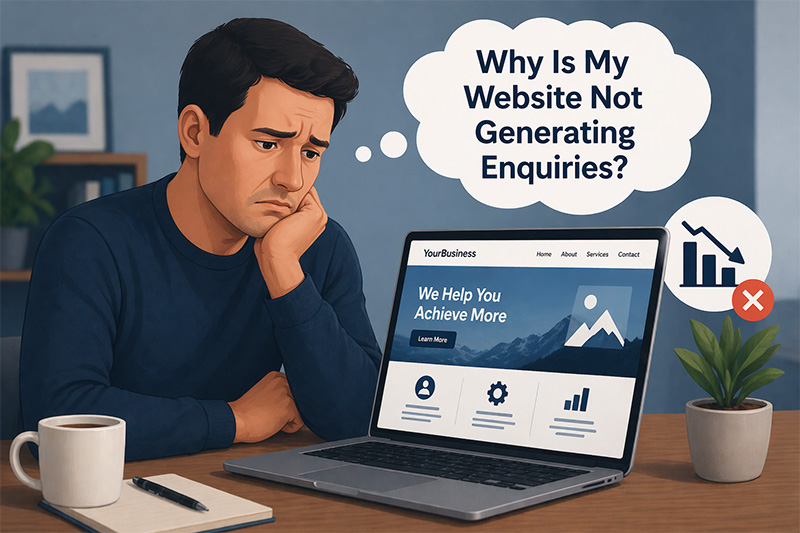
Are you a small business owner, marketer, or website manager struggling with a website not generating enquiries? If so, this guide is for you. For many businesses, a website is the main channel for attracting potential customers, but even with steady traffic, you may find enquiries remain low. Solving the problem of low website enquiries is crucial. Without a consistent stream of potential customers reaching out via form, call, or chat, your business misses valuable leads and growth opportunities. This guide will help you understand why your website may not convert visitors into enquiries, and provide actionable steps to fix it.
Low website enquiries often stem from a mismatch between user intent and the content provided. If your website does not clearly explain what you do or what services you offer, visitors can become confused and leave without taking action. Additionally, the quality of your website traffic, the level of trust you build, and any friction in your user experience all play a significant role in whether visitors choose to inquire. Addressing these issues is essential for turning website visitors into real business leads.
Before diving into the details, let’s clarify some key terms to avoid confusion:
Glossary: Key Terms
- Enquiry: A potential customer reaching out to your business via contact form, phone call, booking calendar, or live chat.
- Lead Generation: The process of attracting and converting website visitors into potential customers (leads) who express interest in your services.
- Conversion: When a website visitor takes a desired action, such as submitting a form or calling your business, they become a lead.
Understanding these terms is essential, as your website should clearly explain what you do and what services you offer to avoid visitor confusion and increase enquiries.
Quick Diagnostic Checklist: Why Is My Website Not Generating Enquiries?
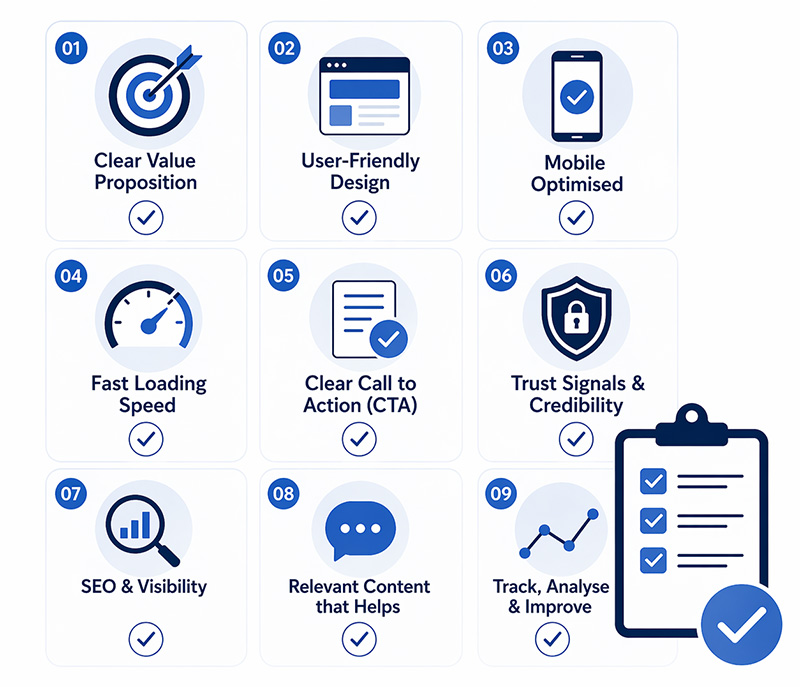
An ‘enquiry’ in this context means a potential customer reaching out to your business, whether by filling out a contact form, making a phone call, booking a calendar slot, or starting a live chat. If your website is not generating enquiries, use this summary checklist to quickly identify the most common issues. Low website enquiries often stem from a mismatch between user intent and the content provided. Your content must align with what visitors expect and need.
- Does your content align with user intent and what visitors expect?
Low website enquiries often result from a mismatch between what visitors are looking for and what your site provides. Make sure your content and calls to action match what visitors expect when they land on your site. - Is your above-the-fold message clear and compelling?
Your website should immediately communicate who you help, what you do, and why you’re credible. A clear above-the-fold message helps visitors understand your offer without confusion. - Is your value proposition clear?
If your value proposition is unclear, visitors may not see the benefit of engaging with your business. - Is it clear what your business does and who you help?
Your website should clearly explain your services to avoid visitor confusion. - Are your calls to action (CTAs) obvious and easy to find?
If visitors can’t see how to contact you, they won’t enquire. - Do visitors always know what to do next?
Visitors should never have to work out what to do next; your site should guide them naturally from one step to the next. - Is there unnecessary friction in your forms or navigation?
Complicated forms or confusing menus can cause abandonment. - Do you build trust with testimonials, case studies, or credentials?
Lack of trust signals can prevent visitors from reaching out. - Is your site fast and mobile-friendly?
Slow load times and poor mobile layouts reduce conversions. - Do you follow up promptly with every enquiry?
Delayed responses can turn warm leads cold.
Visitors often leave within seconds if they cannot immediately understand what you do and how it helps them. Addressing these points will help you diagnose and fix the most common reasons your website is not converting visitors into enquiries.
Why A Lead Generation Website May Still Be Underperforming
Even if your website is designed for lead generation, it may still underperform. Websites that have grown without a clear plan often struggle to generate enquiries due to a lack of structure. Simply adding more features or trying to drive more traffic is less effective than addressing foundational issues like structure and messaging.
Visitor Intent and Content Mismatch
Visitor intent often misaligns with page content, leading to high bounce rates despite steady traffic. If your content does not align with what users are searching for, their search intent, they are unlikely to enquire.
Weak Above-the-Fold Messaging
Weak above-the-fold messaging leaves visitors uncertain about who you help and what outcome you deliver. Clarity in your messaging is essential; your value proposition should be immediately obvious. Clear, customer-focused headlines should also proactively answer common visitor questions or objections, helping build trust and encourage more enquiries.
Friction in User Experience
Friction in forms, navigation, site speed, or mobile usability causes abandonment before a single attempt at contact is made. Poor mobile usability is a common source of friction, especially as more people browse and enquire from their phones. Reducing these barriers is key to increasing conversions.
Once you understand why your lead-generation website may be underperforming, the next step is to examine the quality of your traffic and its impact on enquiry rates.
Traffic Quality Vs Lead Generation
Not all website traffic is equal. Many visitors arrive at your site via Google and other search engines, often searching for specific services or answers. Optimising your website for these sources through search engine optimisation (SEO) can improve the quality of traffic and increase the likelihood of genuine enquiries.
The Importance of Traffic Quality
High visit numbers mean little if users arrive with the wrong intent or at the wrong stage of the buying funnel. Focus on attracting relevant visitors ready to enquire.
Channel Mix and Conversion Rates
Organic, paid, and referral sources produce different conversion rates. The mix of these channels affects your enquiry volume. Email marketing campaigns can also be an effective channel for driving enquiries, and are worth considering alongside these other sources.
Behaviour Metrics
Behaviour metrics like time on page and scroll depth reveal whether your pages attract enquiry-ready visitors.
Once you understand your traffic sources, it’s important to focus on the landing pages that should convert visitors into enquiries.
Landing Pages: The Pages That Should Be Generating Enquiries
Your landing pages are critical for converting visitors into leads. Each web page should be carefully optimised to encourage enquiries, with clear calls to action and straightforward messaging. Well-structured website pages, especially those designed as landing pages, play a key role in guiding visitors towards taking action, whether that’s filling out a form, making a call, or requesting more information.
Intent Match and Clear Outcomes
Top-performing landing pages align with visitor intent, demonstrate outcomes, and feature a single, obvious CTA.
Page Speed
Page load time and site performance under three seconds materially improve mobile engagement and reduce form abandonment. A one-second delay in page speed can drop conversions by 7.2%, and 40% of users will abandon a site that takes more than three seconds to load. Technical speed directly impacts conversion rates, so optimising page load times and reducing unnecessary code are essential actions. Content Delivery Networks (CDNs) can serve content from servers closest to the user, enhancing site performance. Optimising images in next-gen formats like WebP or AVIF can significantly reduce payload size without sacrificing quality.
Mobile Layout
A mobile-first layout is essential, as over 60% of web traffic now comes from mobile devices. Ensuring your website is easy to use and features prominent contact options on mobile devices increases conversions from smartphone users.
Contact Options
Providing multiple, easy-to-find contact options, such as form, phone, and chat, ensures visitors can reach out in their preferred way. Including relevant links within calls to action or contact forms can further enhance the user experience and encourage more enquiries.
Effective use of whitespace on your website can help create a more professional appearance and improve engagement, making it easier for visitors to focus on what matters most.
With your landing pages optimised, the next focus is on the forms and microcopy that can make or break your lead generation efforts.
Forms And Microcopy That Stop Losing Leads
Optimising your forms and supporting text can significantly reduce abandonment rates and increase the number of successful enquiries.
- Keep the field count minimal: Fewer than six fields capture the essentials while reducing abandonment risk. In fact, simplifying contact forms by removing just one field can increase conversions by 11%.
- Use inline validation and friendly error messages: These reduce frustration and encourage successful resubmissions. For example, a clear validation message like “Please enter a valid email address” helps users correct mistakes quickly.
- Reassure with microcopy: Let users know about response time or how their data will be used to reduce hesitation. For example, a line beneath the submit button, such as “We’ll respond within one working day”, can set expectations and build trust.
- Provide obvious fallbacks: Offer a phone number, booking calendar, or live chat when the form fails.
After optimising your forms, it’s time to ensure your copy and messaging are compelling enough to drive visitors to take action.
Copy, Messaging, and Generating Enquiries
Your website’s copy and messaging play a crucial role in converting visitors into leads. It’s important to tailor your messaging specifically to commercial clients, addressing their unique needs and expectations. Avoid generic advice, focus instead on providing tailored, practical solutions that speak directly to your audience.
Customer-Focused Headlines
Headlines that state who you help and the specific outcome increase click-to-contact rates.
Specific Claims for Credibility
Specific claims, such as timeframes or sample results, outperform vague adjectives in terms of credibility and relevance.
Addressing Objections
Address common objections early on the page to shorten the decision path towards contact.
Effective messaging should not only encourage enquiries, but also support direct sales, helping convert visitors into paying customers or clients.
When it comes to handling objections, proactively answer common questions and concerns before they arise. This builds trust and reassures potential clients, making it easier for them to take the next step.
Once your messaging is clear and persuasive, building trust with visitors becomes the next priority.
Trust Signals, Case Studies, and Social Proof
Trust is essential for encouraging visitors to make an enquiry. Showcasing your company as a trusted and professional entity helps reassure potential clients and sets your business apart. Including details about your company’s awards, accreditations, or reputation can further build confidence.
Case Studies with Measurable Outcomes
Case studies that include percentages or timelines give visitors concrete evidence of your capability.
Testimonials Near CTAs
Placing testimonials near calls to action reinforces trust at the moment of the decision.
Professional Credentials and Local Associations
Displaying credentials, local associations, and team photos reduces perceived risk for small-business buyers.
Displaying genuine customer reviews, testimonials, and case studies can have a measurable impact on conversion rates. Research shows that adding customer reviews can increase conversions by 15%-20% (Source: Capital One Shopping – Online Reviews Statistics), with even greater improvements depending on how and where they are presented on the page.
With trust established, making small, targeted changes to your site can often lead to a noticeable increase in enquiries.
Small Changes That Often Produce More Enquiries
Implementing small, strategic changes can quickly boost your enquiry rates:
- Add an in-page contact form: This typically doubles enquiries compared with a hidden modal or button.
- Test CTA wording and colour: Small tweaks in context can yield measurable uplifts within weeks.
- Replace stock images with local staff photos: This improves trust, especially for neighbourhood-focused small businesses.
- Work with a dedicated design team: A design team can help identify and implement targeted adjustments that enhance visitor engagement and encourage more enquiries.
After making these on-site improvements, it’s important to have a solid follow-up process to turn enquiries into real conversations.
Follow Up: Turning Enquiries Into Conversations
How you handle enquiries after they arrive is just as important as generating them.
- Respond quickly: Fast response times materially increase conversion from enquiry to booked call; aim for same-business-day replies.
- Track and log calls: Call tracking and CRM logging ensure offline enquiries are measured and followed up consistently.
- Send automated acknowledgements: Automated emails reduce no-shows and start the qualification conversation immediately.
If you’ve tried these improvements and still see limited results, it may be time to consider whether a new website is needed.
When A New Website Is Actually Needed
Sometimes, a new website is the best solution for persistent issues. If ongoing problems cannot be resolved, it may be necessary to create a new website with a clear purpose and structure, designed to generate enquiries, rather than simply serve as an online brochure.
Platform Limitations
A new website is justified if the current platform prevents necessary conversions, tracking, or accessibility fixes.
Structural Issues
Large structural issues, such as confusing information architecture or mixed messaging, can warrant a rebuild.
Legacy Code and Plugins
If multiple high-impact fixes are blocked by legacy code or plugins, migration may deliver faster gains.
After making changes, it’s essential to measure their impact and continue optimising for more enquiries.
How To Measure Improvements And Increase Enquiries Responsibly
Follow these steps to ensure your changes are effective and sustainable:
- Track conversion rate by landing page and traffic source to prioritise the highest-return changes.
- Use short A/B tests for CTAs and forms, and measure the effect on enquiries before wider rollout.
- Prioritise fixes that deliver the biggest impact per hour of work, rather than chasing marginal gains.
To see how these strategies work in practice, let’s look at some real-world case studies.
Case Studies That Illustrate Bigger Impact
Real businesses have seen significant improvements by applying these principles:
- Messaging and form simplification: Commonly produces double-digit percentage increases in conversion.
- Adding a testimonial or case study often noticeably shortens the enquiry decision cycle.
- Localised imagery and clear contact routes: Frequently convert more local enquiries than broader redesigns.
With these examples in mind, you can see that focused, evidence-led improvements can make a substantial difference.
Final Thoughts
Most enquiry problems are solved with focused diagnosis, modest changes, and consistent follow-up. Start with pages already receiving traffic, align intent, reduce friction, strengthen trust, then measure. For local small businesses, steady, evidence-led improvements generally deliver the best long-term increase in enquiries.
Behind the Scenes: How We Ensure Accuracy, Expertise and Transparency

About the Author
Fari Peyman is the Managing Director and founder of Notting Hill Biz, established in 1998. With nearly three decades of business and online technology experience, he leads a team specialising in creating websites that are easy to manage and deliver real results for small and medium-sized businesses. A seasoned business consultant and networker, Fari thrives on helping companies grow through innovative web design and organic SEO.
When he’s not working with clients, Fari enjoys martial arts and photography. Connect with him on LinkedIn to explore how your business can benefit from expert web design and SEO.